

Shared Ownership Pros and Cons
If you’re finding it difficult to get a foot on the property ladder, you might want to consider buying a shared ownership house.
As an alternative to buying outright, shared ownership is an affordable home ownership scheme that sits somewhere between renting and buying. More importantly, however, shared ownership often minimises one of the biggest challenges of buying a house - getting a large deposit together.
While we’ve written more about how to buy with shared ownership, this article will explore the shared ownership pros and cons that might affect you when you buy a shared ownership home.
Why Choose Shared Ownership?
Over the last decade, Shared Ownership has risen in popularity, particularly since Help to Buy ended and affordability issues in the market persisted.
As of 2026, around 250,000 people in the UK currently live in a shared ownership home, an increase of 23% since 2020, highlighting just how popular affordable home ownership schemes currently are.
The reason for this increasing popularity is due to the flexibility and accessibility it provides, especially in terms of getting a deposit together.
While buying on the open market often requires a deposit based on the full market value of the property, buying through Shared Ownership may only require as little as 5% deposit on your initial share.
This makes the bar for entry much lower, especially in desirable areas that are potentially more expensive and particularly for first-time buyers. As of 2026, 71% of shared ownership sales were to first-time buyers over the last year, with just over 18,000 completed in total.
Likewise, shared ownership is a fantastic option if you plan to stay in the property for several years. Considering the majority of shared ownership buyers are also first-time buyers, this is usually the case and shared ownership is unique in that it offers more security than private renting and allows you to start building equity, all with a reduced risk of losing money if prices fall.
- Available

The Fulwood, Hartley Mere
Semi-Detached House
Part of Hartley Mere, Peterborough, Whittlesey, Peterborough Prices from £26,000 for a 10% share Register your interest - Coming Soon

The Chester
Semi-Detached House
Part of Thatchbrook, Queniborough Price to be confirmed Register your interest - Coming Soon
The Singer
Semi-Detached House
Part of Thatchbrook, Queniborough Price to be confirmed Register your interest -
- Early Bird
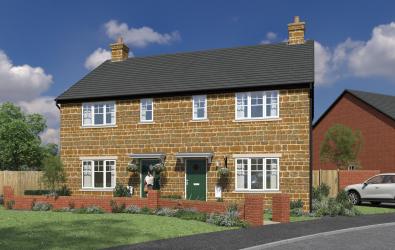
The Fairford
Semi-Detached House
Part of Norwood Farm, Harpole Prices to be confirmed Register your interest
What are the Shared Ownership Pros?
When we look at both shared ownership advantages and disadvantages, there’s definitely some factors that can change depending on your own individual circumstances. Below are some of the fundamental advantages of shared ownership:
Accessibility
The main advantage of shared ownership is that it’s much more accessible than buying outright.
Since you’re only paying for a certain share of a property and not the whole thing, this often means you need a smaller mortgage and thus, a smaller deposit.
While you still have to pay rent and a reduced mortgage payment, which may be around the same as a full mortgage repayment, you don’t have to scrape together a huge deposit which can often be the biggest hurdle.
At the same time, another advantage of shared ownership is that while you’re still paying a form of rent, the share of the home that you own can increase in value in line with local house prices. This means that you’re still building equity which is useful when you take your next step.
Flexibility
Another great shared ownership pro is that it’s very flexible for the buyer. You can always buy a larger share of the property and work towards full ownership at your own pace.
This process is called staircasing and can be in small steps or one large chunk, depending on how your financial situation changes.
While it’s important to remember that you’ll be buying a share at the current market value - not the original price - the opportunity to buy whenever you’re comfortable is often very reassuring for new homebuyers.
Desirable locations
Since you’re buying with a lower deposit and at a lower overall value, shared ownership homes are often a great option for purchasing in more desirable, expensive areas.
Platform has a number of new homes in extremely popular areas that are specifically for shared ownership buyers which is great if you have your heart set on an area with great schools or local amenities.
This is a unique advantage to shared ownership and often opens up many more opportunities for homebuyers that wouldn’t usually be possible.
Who is Shared Ownership For?
So we know the pros and cons of shared ownership but who is it perfect for in the long-term?
As always, it all depends on your individual circumstances and you should always speak to a financial advisor before considering shared ownership. That said, this home buying scheme can work for you if:
You can't afford to buy a home on the open market: As you might expect, shared ownership is ideal for people that will struggle to buy a home on the open market. In most cases, the biggest hurdle is getting together a deposit and shared ownership makes this significantly easier.
You have a stable income but not a huge amount of savings: In many cases, households have a decent income but struggle to get started as they don't have a huge amount of savings. With shared ownership, you'll often pay less on a monthly basis than you would when private renting but you can start building equity immediately.
You're looking for a long-term home and/or don't mind staying in the same area for several years: As we've mentioned above, shared ownership is best viewed as a long-term investment. In most cases, you'll steadily staircase over several years, reducing your monthly rental payments whilst working towards full home ownership. As you might expect, doing this over the short-term is possible but not typical as it costs significantly more than just buying outright when we take additional costs of staircasing into account.
You're looking for a new-build home over a typical rental property: One of the aspects of shared ownership that is less spoken about is how useful it is for people seeking a certain type of property. If you want a house with a certain number of bedrooms or a garden, shared ownership is often a fantastic alternative to the different rental properties you'll find on the market, which are increasingly apartments or smaller homes. While this is obviously dependent on the area you're buying in, shared ownership often guarantees a high-quality new build property in a desirable area.
A Complete Guide to Shared Ownership
Download the latest Shared Ownership Guide and discover everything you need to know about the fastest growing home ownership scheme in the UK, including how Shared Ownership works, the benefits and who is eligible for the scheme.
Download Shared Ownership GuideWhat are the Shared Ownership Cons?
As with any large purchase, it’s important that you do your due diligence and research the process fully. The same applies to shared ownership and some of the pitfalls that can impact homebuyers. Here are some of the shared ownership disadvantages that you’ll want to consider if you're buying through the scheme:
You’re still a tenant
It’s important to remember that while you’re only paying rent on a share of the property, you’re still a tenant and certain rules apply.
You can still be evicted if you fail to pay rent, regularly causing disturbances for neighbours or not following the rules for sub-letting and similar instances.
This means it’s up to you to make sure that you can afford both the rent and the mortgage payments before you take on a shared ownership property.
Stamp duty considerations
While you don’t pay stamp duty as a first-time buyer, the rules shift slightly if you buy a shared ownership home. First-time buyers of a shared ownership home pay no stamp duty on the first £425,000 of any home that costs up to £625,000.
However, it’s possible to pay stamp duty in two different ways - either based on the full amount upfront or just on the share that you’re buying.
If you pay the full amount upfront, this is obviously a higher expense but you never have to pay it again, even if you buy the whole property outright.
If you pay the stamp duty on the portion, this is obviously a lower initial cost but you will have to pay again (and potentially more) when you staircase to an ownership share of 80% or more.
It’s important to talk to a financial professional, solicitor or our team at Platform if you want to know more about how stamp duty impacts shared ownership and first-time buyers.
Service charges
Regardless of how low your share is, you'll likely have to pay any ground rent or service charge that is present on your property.
It’s important to remember this when you’re planning your finances and how it might change throughout the process.
Who Should Avoid Shared Ownership?
As always, shared ownership is not necessarily for everyone and if the following apply, you might want to look at other schemes available:
You're not eligible: We'll start with the most obvious but if you're not eligible for shared ownership, it'll be a waste of your time starting the process. Always read through the eligibility rules and make sure you fit the criteria.
Your circumstances aren't secure: If you work in a role where you move around or there's potential for relocation, shared ownership may not be for you. Buying through shared ownership is best seen as a long-term investment and if you only buy in for the short-term, you may find yourself losing out financially.
Your income fluctuates: Many people are self-employed and have fluctuating incomes, which may not always align with a shared ownership purchase. If you'd struggle to absorb changing costs, such as repair costs or service charges, you may want to look elsewhere.